Margin Focus · for brewery owners and their leadership teams
Grow profitably by knowing where margin is made and lost and keeping the whole team focused on it every week.
I help brewery owners and their leadership teams understand where margin is made and lost, decide which levers to pull, and keep the team focused on them week after week. It starts with a deep dive on the data the brewery already has.
Sample data · demo brewery
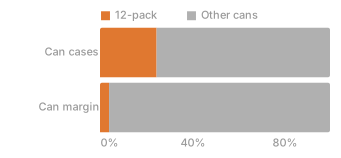
12-packs are 25% of the cases of cans this brewery sells and 4% of the margin the cans make.
The brewery is busy, the team is working really hard, and profit isn't keeping pace.
Gross margin is the profitability engine of a brewery. People all across the team make decisions every day that change it, and they often don't see the result until it's too late.
Something I see a lot with brewery owners:
- Margin reporting sits too high to act on.Everyone knows margin needs to improve, and nobody can say which specific actions would do it. The monthly review turns to theories (aluminum, the distributor, the taproom), and it can get close to pointing fingers.
- The numbers live in different systems.The accounting system, the brewery software and the sales reports don't talk to each other.
- Cost per beer stops at materials.Labor and overhead get spread flat per barrel and promotions sit on one line in the books, so a keg and a 12-pack look alike and it's hard to trust the number.
- The big decisions get made flying blind.A price increase, a new package or a beer someone wants to cut gets decided without a number behind it, and the owner carries that weight until the financials come in.
Know what every beer, package and channel makes and get the whole team behind a plan you trust enough to grow against.
Decisions get made with more confidence, the hard conversations get less personal, and margin becomes something the whole leadership team works on together. It runs in three steps.
1 · The deep dive
See where margin is made and lost today.
I vacuum up the data the brewery already has in the brewery software, the books, the sales reports and the labor, and check it against the report you trust until it matches. Labor and overhead go onto each beer and package by the hours it takes to make. Where hours aren't tracked, the packaging lead and head brewer estimate them, and they're marked as estimates.
That's how the 12-pack at the top of this page shows up: it sells well, but between the hand-packing it needs and a lower price a case, labor and overhead take 42% of what the distributor pays for it, against 29% to 31% on every other package sold wholesale.
- What every beer, package and channel makes, with labor and overhead on it
- Whether the story is mostly price, cost or mix
- The three biggest opportunities, each with a rough size and who would own it
2 · The roadmap
Decide where you want to go and what closes the gap.
We talk about where you want to take the business and size the gap between here and there. Then we pick a few initiatives across price, cost and mix and try them on your own numbers before you commit. That could be a price change and how much volume it can afford to lose, more of the sales going to the packages that make more, or a change in an ingredient or packaging cost and what it does to every margin.
One of them we work through together in depth, down to the steps it takes and the numbers that will show whether it's working. Ninety days later we look at what each one did.
- Where you want to go, and the gap in dollars
- A few initiatives, each with an owner, the steps to get it done and a date to check it
- One worked through together in depth
Sample data · demo brewery
Margin ran between 2.9 and 4.3 points under plan each month from January to April. At the plan margin, what it sold would have made $171,100 more.
The three initiatives the team picked
Price Sales director · first check July 6
A $2 a case increase on the 12-pack at independents and $4 a keg on wholesale sixtels, with notice to the distributors, sized before any lost volume
$68,800 a year
Cost Operations director · first check June 15
A leaner 12-pack run: a quarter fewer hand-pack hours, and pack loss down from 3% to 2%
$22,900 a year
Mix Sales director · first check May 25
Promotions off the 12-pack wherever they aren't holding a chain slot, and sales incentives toward the six-packs and kegs
$16,200 a year
3 · The Spotlight
Every Monday each person sees their own piece of margin.
Your systems get connected, so the numbers refresh on their own. Each person gets a short email on the part of margin they own and what changed it last week. The leadership one, shown here, gives each of the three levers a status (helped, about level or hurt) with the brand and package behind it.
Behind it, every beer, package, region and canning run is checked each week against the 4 weeks before, far too much to track by hand. Only the few that changed margin the most in dollars make the email, while they're still small.
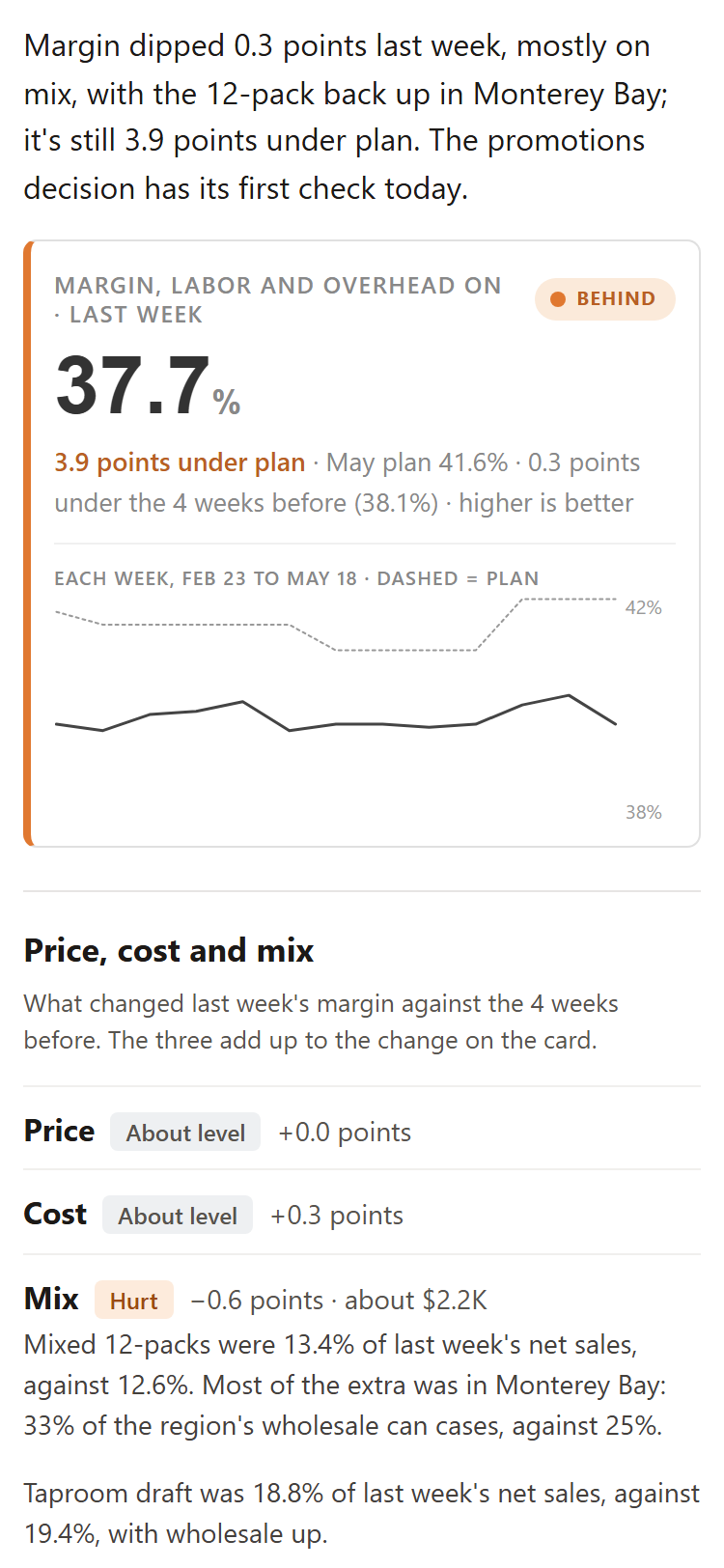
The leadership email on a demo brewery, with sample data.
3 · The Spotlight
Every initiative gets checked against what the team expected.
- The email follows upWhen an initiative reaches its check date, the email puts what the owner expected next to what happened. Anything the team agreed to and hasn't marked done comes back as a reminder.
- They mark it doneOne tap marks it done. If they want it tracked, they say what they expect it to do, in their own words.
- The next email checks the resultThe next Monday, the email checks it against what they expected: there, most of the way, or not yet.
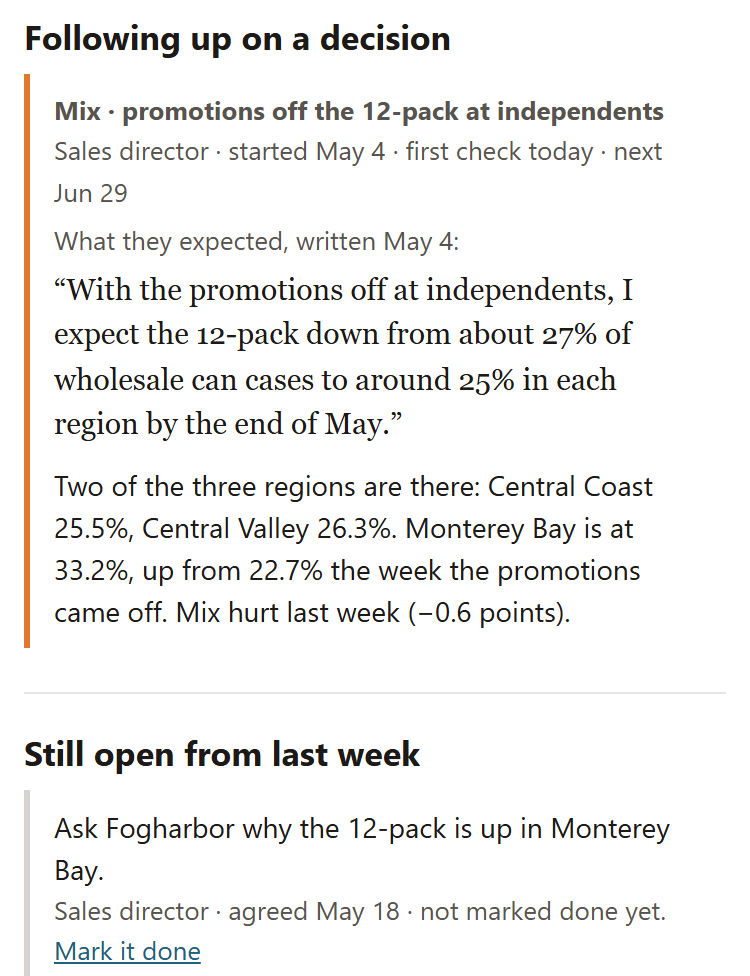
Ways to start.
Visibility
The deep dive
The place to start
You send what you already have, and within a few weeks you see where margin is made and lost and the three biggest opportunities.
Plan
The roadmap
After the deep dive
It runs on the files you send too, so nothing needs connecting yet. One initiative worked through together in depth comes with it, and more can be added.
Under control
The Spotlight
Once the roadmap is set
This is where your systems get connected. It's priced by which systems we connect and how many people it reaches.

Knows beer and the numbers behind margin.
I've spent about 20 years in data and technology, the last several focused on beer, working with more than a dozen breweries and industry partners. A lot of that work this year has been margin: what a beer costs and makes by package and channel, and how to decide what to do about it.
Questions owners ask.
Do we have to change systems?
No. The deep dive and the roadmap run on files the brewery already exports, and the Spotlight connects to the accounting system, brewery software and sales reports you already use.
Do we have to do all three steps?
No. The deep dive stands on its own. The roadmap builds on it, and the Spotlight builds on the roadmap.
Will it tell us what to charge, or which beers to cut?
It shows what each option is worth and what it would take. The price, the beer and the timing stay the owner's decision.
Let's talk about where you want to take the business and what it would take to get there profitably.
First we make sure everything is making money. Then you can hit the gas on growth with the sales team.
It fits best when there's a decision on the table you can't put a dollar figure on yet. The first step is a conversation about how the brewery looks at margin today, and whether a deep dive makes sense.
Or email me at jeremy@centralcoast-analytics.com