Brewery Brainby Central Coast Analytics Find out if we can help

Hit your number knowing every week where your team stands, what's driving it, and where to focus next, without pulling a single report.

I help brewery sales leaders get there. You also get planning and communication tools, all built on the same data you can trust.

Sam's SpotlightDirector of Sales · week of August 10

Good morning, Sam. Coastline is on pace for 97% of the quarter's goal, a little short.

Chain compliance

89% against a goal of 95%, down from 91% four weeks ago. Most of the gap is in Jordan's team.

Core brands on the shelf

79% against 82%, about the same as four weeks ago. Most of the gap is in Nina's team.

Draft handles held

80% against 87%, down from 85% four weeks ago. Most of the gap is in Jordan's team.

Where help counts

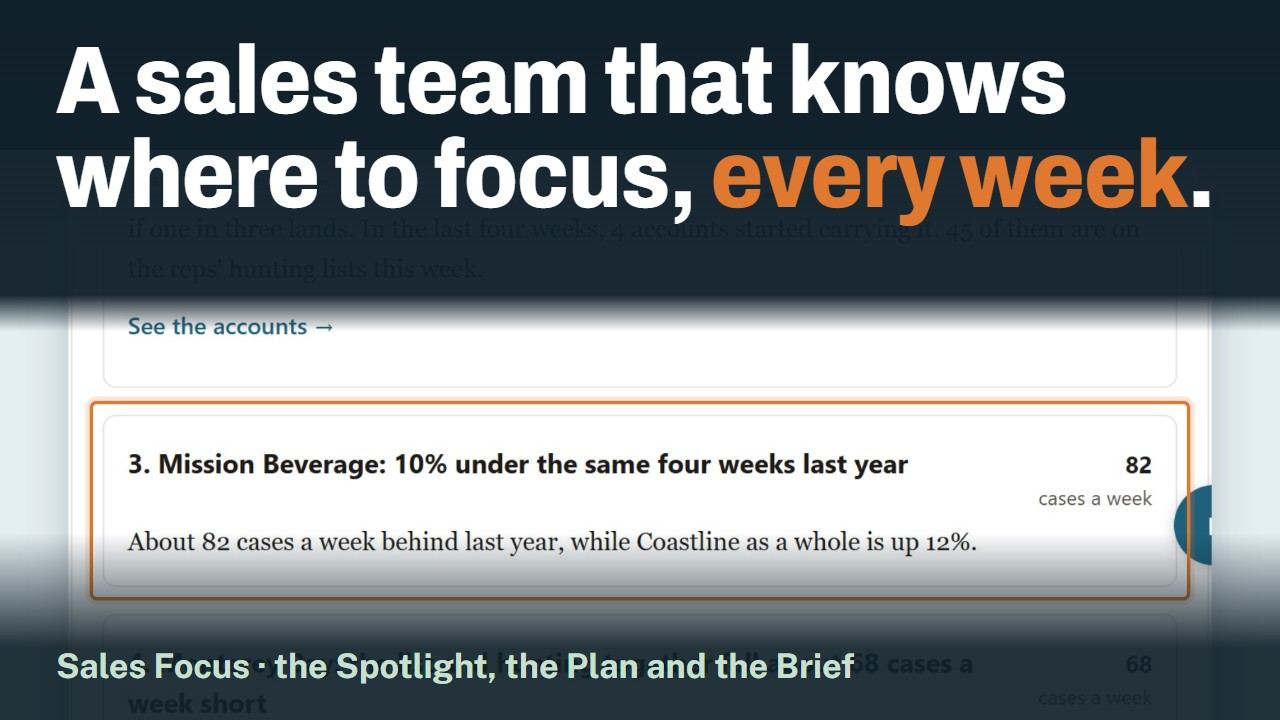
Mission Beverage is short about 161 cases a week. Maya's list brings back about 90 of them.

A sample Spotlight from a demo brewery · about a minute to readExample: Sam's Spotlight, on a demo brewery →

Your team is working hard, and the effort doesn't always show up in the numbers.

Something I see a lot with brewery sales teams:

  • It's hard to know where to focus.Which accounts, items and reps need attention this week, and where to go hunt for new business.
  • Insights on depletions show up late.What matters is hard to dig out of the portals and spreadsheets, so a distributor pulling back or a chain item that never shipped isn't caught until weeks after the fact.
  • Hours go to building reports.Reps and managers spend time in spreadsheets instead of out in the market.
  • Goals are hard to set fairly.And harder to track, so it's tough for each rep to know where they stand.
  • Reps are on the road, on their own.They're on their phones, not behind a computer, with less time with leadership. Getting them what they need, and supporting them, is harder.

Less of the week behind a computer, reps in the market on the accounts that matter, and a sales leader the CEO trusts to drive the growth, with the numbers to show it.

The Spotlight comes to you every week, the Plan is there whenever you need to think something through, and the Brief is ready before each meeting.

All three run on the same data. Adding the team's knowledge, and following through on the actions, is what I'm building with sales leaders now. One brewery's sales team runs the Spotlight in the field today, and their feedback is shaping the rest.

A rock solid data foundation, before anything else.

Your depletions, CRM and goals get connected once and refresh every night. The first step is checking it against the report you rely on today, the one you'd call your source of truth, until everything ties out 100%. Nobody sees an insight until the foundation is rock solid. From there, it runs on a set framework, with scheduled pipelines and the same checks every night, so it stays right long after day one.

The Spotlight, the Plan and the Brief on a demo brewery, as a single system, in about four and a half minutes. Every account, person and number is sample data.

Planning

A plan built from your story, and tools to test ideas whenever you need them.

The Plan starts with your story: where your team is and where it needs to go. We work through it together, and I help turn it into initiatives and goals that add up at every level.

Before each meeting

The decks and emails for each meeting, drafted before you walk in.

You set each meeting up once: who it's for, the time it covers, what it focuses on and how much detail. When the month's depletions are in, the PowerPoint decks and emails are drafted from them, ready to edit and send.

What changes

  • You get pointed in the right direction faster: less of your week goes to pulling data and assembling reports, and less to figuring out on your own what it all means.
  • Meeting prep goes from a three-to-four-hour spreadsheet and PowerPoint exercise to a 30‑minute review.
  • A slipping account gets flagged the week it shows up in your depletions, in a lot of cases two to four weeks earlier than it would have been caught.
  • Goals that add up: if every rep hits theirs, the team hits its number.
  • After 90 days, you can see in your own numbers how many flagged accounts came back, and what they were worth.

When you're ready, the same view can go out to each manager and rep.

Jeremy Carney

Knows beer, and the data you live in.

You didn't get into beer sales to spend your week piecing massive spreadsheets together or heads down in dry depletion reports, and neither did your reps. Your time and your team's time belong in the market, with your customers.

Depletion portals, CRMs and chain reports each show one piece. I've spent years inside that data for beverage brands, connecting the pieces and adding the team's context.

About 20 yearsin data and technology
More than a dozenbreweries and industry partners

Ways to start.

You can start small, with one question on the data you already have, and build from there.

A Deep Dive on one sales question

The place to start

Pick the one sales question you care most about right now. You get a clear picture back you can take to the CEO and CFO, with ideas on what to go after first.

What it looks like

I work from the exports you already pull, so it won't take your reps off the road.

For example

  • Where you're authorized but not shipping
  • Which accounts are slipping, and what's behind it
  • What next quarter looks like by item and distributor

The Spotlight

The weekly work

The week described above, for every rep, manager and sales leader on the team: where each rep stands on their goals, the accounts worth their time and why, and a check on what shipped after the visit.

Once your depletions, CRM and goals are in, the Spotlight can usually start going out to your team the next week, and it gets dialed in from there.

What it looks like

You don't have to start with the Plan. If you already have goals, it uses those, and you can reset them in the Plan later.

Example: the Spotlight, on a demo brewery →

The rep, manager and sales leader views, on a demo brewery with sample data

Whichever you start with, the aim is the same: take the recurring reports, notes and decks off the team's plate, so their time goes to the market. Anything that goes to a distributor or a customer is drafted for a person to check and send.

Questions sales leaders ask.

Do we have to change the CRM or depletion portal we use?

No. Your team keeps the portal, CRM and reports it runs today, and I build on top of them.

How do my reps get it?

In the normal course of their week, on their phone: a text, an email, or a message in Slack or Google Chat, with a link to their own page when they want to dig into an account.

Will my reps actually use it?

That's the question I care about most too. It's built to reach them where they already are, on their phone, short enough to take in between accounts, with more places to look than they need so they make the choice. A team's first weeks with it are where we find out, and adjust.

How much of my team's time does it take to get started?

Very little. A Deep Dive runs on the exports you already pull, so it won't take your reps off the road. After that, the setup needs an hour or two from whoever knows your systems and the business best, mostly answering some questions from me.

Let's talk about where you want to take sales from here.

If your reps are spending Mondays in depletion reports, or you're finding out about a slipping account a month late, you're feeling this already.

The first step is a 30-minute conversation. We'll talk through how your team decides where to focus today, and where better information could help.

Or email me at jeremy@centralcoast-analytics.com